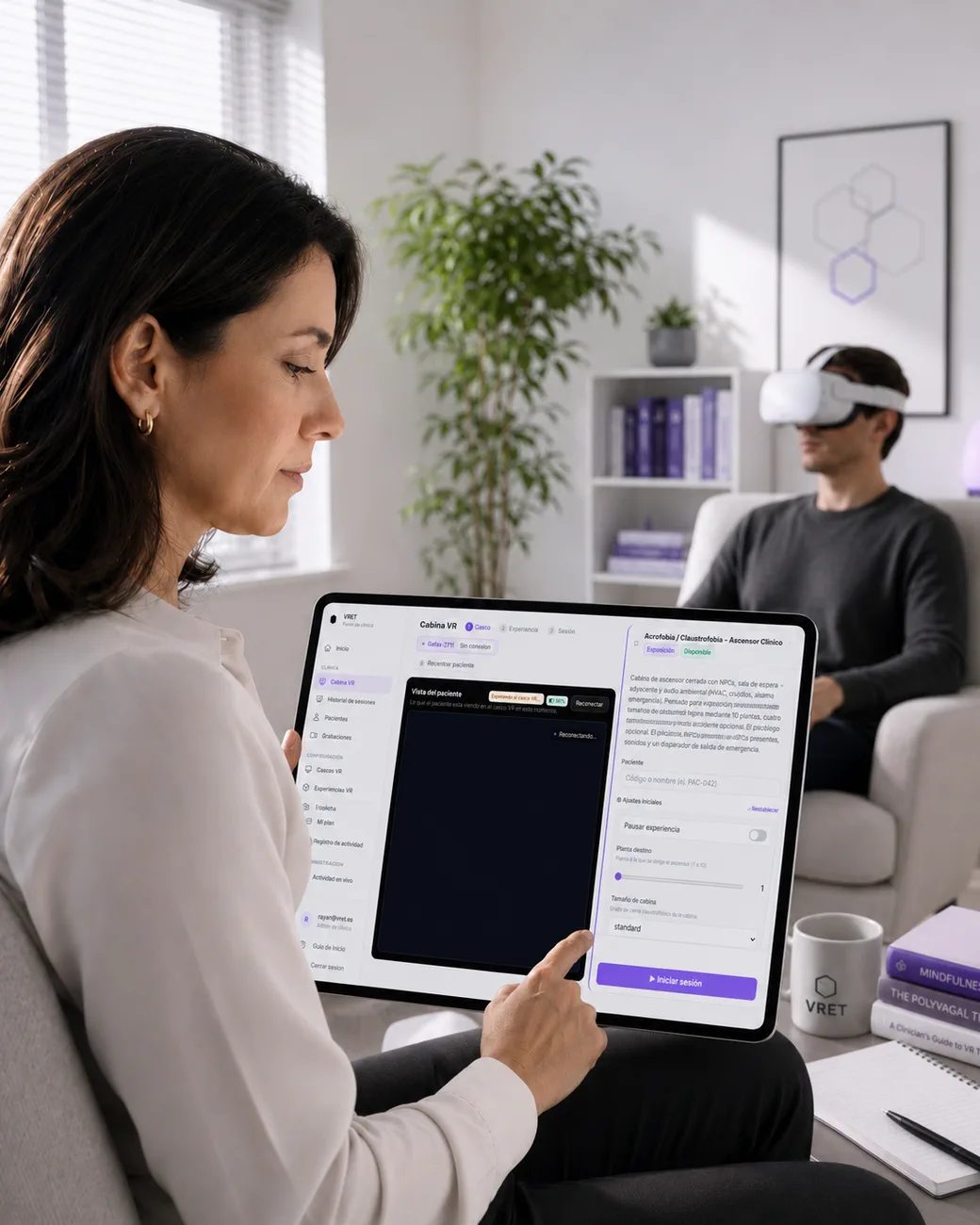
Virtual reality exposure therapy, run by the clinician. Priced per practice, not per headset.
VRET is a VR exposure therapy platform for clinicians: you launch the scenario, set the intensity, and pace every session in real time from your browser while the patient wears a Meta Quest headset. One subscription per practice — from $119/mo — replaces per-headset pricing, so adding a device never doubles your bill. Human support, EU-hosted infrastructure, and a 30-day money-back guarantee on every plan.
A 30-minute call with a licensed clinical psychologist. No credit card, no commitment. See our security & GDPR page.
Clinical advisor is a licensed, practicing psychologist
Human support, not chatbots
30-day money-back guarantee on every plan
−47%
fewer patients drop out of therapy vs. in-vivo exposure
VRET in-clinic patient tracking
24h
from the onboarding call to your first patient in the headset
Average go-live · VRET customers
3 min
to set up an exposure session in your office
Average per session in real-world use
20+
years our clinical advisor has treated phobias and anxiety, behind every scenario
Licensed clinical advisor, in active practice
How it works
From demo to your first clinical session in 24 hours.
We handle the full onboarding — you bring the headsets (Meta Quest), we run a 30-minute call, and your practice is live. No installs, no IT department, no excuses.
STEP 01
We set up your practice
We pair your VR headsets (Meta Quest 2, 3, or Pro — your practice supplies them, and we help you choose if needed), add your team, and select the scenarios that fit your caseload.
setup wizard · pair headsets · team · scenarios
STEP 02
You launch the session
Pick the scenario, intensity level, and environmental variables. The patient puts on the headset and you watch everything from the control cockpit in your browser.
control cockpit · scenario · intensity · variables
STEP 03
You monitor and document
Track SUDS and clinical markers in real time, timestamp observations to the minute, and the session report is ready for the chart the moment you close the session.
auto-export PDF · timeline · notes · progress
VRET vs. per-headset platforms
Same patient, same headsets. Not the same invoice.
Three comparable practices — 4 headsets, one year, the same exposure scenario. Here's what the numbers look like once you stop paying per headset and start paying per practice.
VR software that charges for every headsetOld model
~$225/headset/mo · your bill climbs every time you add a team member
12-month lock-in · cancel early and you pay a penalty
Five exposure scenarios included · everything else costs extra
Support in a distant time zone · 24–48h average reply
A data agreement you can't negotiate · no clinical input on the roadmap
No guarantee: if it doesn't work for you, you still pay
VRET — one subscription per practiceVRET model
$289/mo for 4 headsets (~$72 each) · same price even as you open new locations
No lock-in · cancel in one click from your dashboard
Full exposure + relaxation catalog · new scenarios land at no extra cost
Support from clinicians · under 8 business hours to reply
EU-hosted, end-to-end encrypted · a GDPR-grade DPA signed on day one
30-day money-back guarantee on every plan · full refund, no questions asked
Who it's for
Built for clinical psychology practice.
Not a repackaged 'digital health' app for therapists. It's a clinical exposure tool designed with a licensed psychologist, used in private practice, and grounded in published literature.
Specific phobias
Dog phobia, fear of flying, claustrophobia, acrophobia, and agoraphobia with a hierarchy you grade from the tablet.
Panic & GAD
Interoceptive exposure in everyday settings: transit, driving, the grocery store, enclosed spaces.
Social anxiety
Public speaking, interviews, first dates, and meals with avatars that react to the patient.
PTSD & trauma
Dosed re-experiencing that fits your CBT or EMDR protocol. You decide when the patient goes in and when they come out.
Relaxation & mindfulness
Guided forest and paced breathing for session closings or between-session practice.
Chronic pain & rehab
Immersive distraction validated in the literature for painful procedures and chronic pain management.
Why VRET (and not another platform)
Six reasons that are hard to copy without rebuilding the product.
01 / PRICING
Priced per practice, not per headset.
From $119/mo, billed per practice. Per-headset platforms double your invoice the moment you add a device. With VRET an extra headset is a flat $69/mo — the base never moves.
02 / CLINICAL ADVISOR
A licensed psychologist behind support.
Our clinical advisor is a licensed psychologist in active practice, not a drop-in consultant. Every protocol, exposure hierarchy, and scenario runs through their caseload before it reaches yours.
03 / CLINICIAN CONTROL
You run the session — the patient isn't playing a game.
Launch the scenario from the tablet, adjust intensity and proximity live, and pause whenever you decide. No mini-games, no gamification pulling focus from the therapeutic work.
04 / ONBOARDING
See your first patient in 24 hours.
A 30-minute onboarding call, pair the Meta Quest headset with a code, and you're working. No on-site install, no IT department, no mandatory EHR integration.
05 / DATA OWNERSHIP
Your data is yours — export it any time.
Export sessions, markers, and metrics to CSV, JSON, or via API whenever you want. On Enterprise it's contractual: if we ever shut down, you get 60 days and a server to pull everything.
06 / SECURITY
Encrypted clinical data on EU-hosted servers.
EU-hosted infrastructure, AES-256 at rest and TLS in transit, a GDPR-grade DPA signed at onboarding, and row-level tenant isolation so each practice only ever sees its own data.
Transparent pricing
One price per practice. Not per headset.
Per-headset platforms bill you for every device. We bill per practice. Open a second office with three more headsets tomorrow and you pay the same. The headsets (Meta Quest 3, around $500) are yours to buy once.
Starter
Solo private practice with 1 headset. CBT and self-guided exposure sessions.
$119/moexcl. tax
or $1,190/yr
1 active VR headset · add another for $69/mo as you grow
Full scenario catalog · dog phobia, heights, flying, agoraphobia, relaxation
Clinician controls during the session: voice, audio, route waypoints, intensity — no coding
2 users (clinician + front desk)
5 hours of session recording per month included — move to Clinic if you need more
Email support under 48 business hours · 99.0% uptime
30-day guarantee · full refund, no questions asked
Prices exclude applicable taxes — calculated at checkout based on your location. Meta Quest 3 headsets (~$500) not included; we'll help you spec them on the demo.
A 30-day money-back guarantee on every plan. If it's not for you, we refund 100%.
You get 30 days of full access, the same on every plan. If VRET doesn't fit your practice in that window, we refund the entire first period — no minimum-usage clause, no card held hostage, no retention call, no fine print.
Book a 30-minute demo and see the clinician cockpit on a real case.
Thirty minutes by video with our clinical advisor. You'll see the cockpit on a real case, we'll answer your specific objection, and if it's a fit, we'll walk you through onboarding. If it's not, we'll tell you.
It's clinical exposure — the first-line technique for phobias and anxiety disorders — delivered inside a virtual environment instead of in imagination or in vivo. The patient faces the feared stimulus (a dog, a plane, a height, an elevator) in graded steps while you, the clinician, control the intensity in real time from a tablet and log SUDS. VRET is the platform that makes this work in your office: software priced per practice, not per headset, with a growing catalog of clinical scenarios.
Do I need to buy the VR headsets?
Yes — headsets aren't included. We recommend the Meta Quest 3 (around $500 each): you pay once, you own them, and they last 3+ years. If you already have Quest 2 or Quest Pro, those work too. On the demo we help you figure out how many you need — most practices start with one, not four.
How is VRET priced, and is there a contract?
Three plans, no lock-in: Starter $119, Clinic $289, and Enterprise $1,499 per month (prices exclude applicable taxes). Cancel from your dashboard in one click. Paying annually works out to 10 months (two months free). Extra headsets are a flat $69/mo each.
Why charge per practice instead of per headset?
Because charging 'per headset' punishes growth. Open a second office with three headsets and a per-headset model adds hundreds of dollars a month; with VRET the price is per practice and extra headsets are $69/mo (up to 10 on Clinic). A flat price per practice is our bet: the more you use VRET, the more you come out ahead.
Is my patient data secure?
Your data lives on EU-hosted, encrypted infrastructure, and each practice only ever sees its own — enforced by row-level tenant isolation, not just a UI filter. Patients are anonymous by design: VRET never receives a real identity, and you manage the pseudonym. We sign a GDPR-grade data processing agreement (DPA) with you, and you can export everything at any time.
What happens if VRET shuts down?
Your data is yours and you can export it whenever you want (CSV, JSON, or via API). On Enterprise it's contractual: if we shut down, you get 60 days and a server to download everything. VRET is funded by its customers, not outside investors — there's no clock running to raise the next round.
What if a patient gets motion sick? Isn't that a liability?
Graphics are tuned to reduce motion sickness (90 fps) — in our data, about 3% of patients feel some discomfort in 20-minute sessions. You always start at intensity 1 with the control in your hand, and we provide a VR informed-consent template for the patient to sign before the first session. Clinical responsibility stays with you, as it does with any technique.
Which scenarios does the catalog cover?
It covers the phobias with the most demand in private practice: dog phobia, fear of flying, heights, agoraphobia (open spaces and public transit), claustrophobia (elevators), and relaxation environments — roughly 80% of real cases. Not yet covered: advanced spider-phobia interaction, military-specific PTSD, or psychosis. On Clinic and Enterprise we can build a custom scenario for a one-time fee.
Is VRET a certified medical device?
In its current supporting role, no. VRET is a professional tool for your work: it doesn't diagnose, doesn't prescribe, doesn't replace your judgment, and isn't used autonomously without your supervision. Clinical indication and supervision stay with you as the licensed clinician.